



December 10th will be the most interesting Fed announcement in more than a year. It's the first time since mid-2024 where a rate cut (or lack thereof) has not been a foregone conclusion. This means the Fed has a chance, albeit a small one, to surprise the market.
The market currently sees a better-than-85% chance of a cut at next week's meeting according to Fed Funds Futures (contracts that effectively allow traders to bet on the future level of the Fed Funds Rate). Typically, futures indicate a 95%+ likelihood of a certain outcome.
The most optimistic conclusion would be that a rate cut would surprise a larger part of the market than normal and thus put downward pressure on other rates. Unfortunately, it's more complicated than that.
Even if 15% of the market is surprised by a rate cut, the impact on longer-term rates will be influenced by several other factors. Most notably, this is one of the 4 meetings per year that includes a dot plot (updated rate forecasts from each Fed member).
The dots get plenty of attention--so much so that they can steal the spotlight from a rate cut decision. For instance, the Fed could cut rates next week, but the dots could show a decreased willingness to consider additional cuts in 2026. If the message in the dot plot was gloomy enough, it could push other rates higher even as the Fed is cutting its overnight rate.
In addition to the dots, the Fed Chair always has an opportunity to push back on the market's takeaway during the press conference that begins 30 minutes after the rate announcement.
Last but not least, the market may simply wait to make bigger moves until it has the results of November's jobs report. The jobs data would have come out today if not for the government shutdown. That would have helped the market further refine its expectations for next week's Fed decision. As it stands, the release is delayed until December 16th.
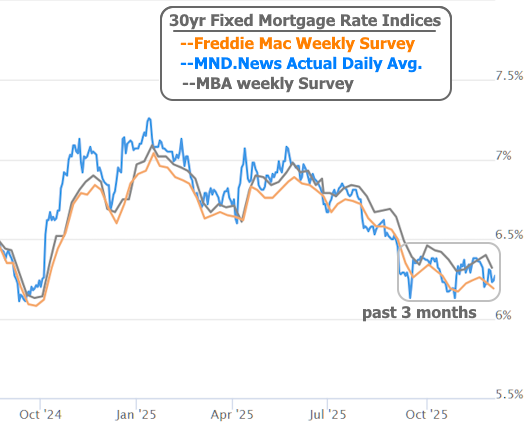
As far as "bigger moves" are concerned, mortgage rates arguably haven't seen any since early September. Since then, average 30yr fixed rates have been broadly sideways near the lowest levels since late 2024.
If there's one potential economic data wild card before Fed Day, it would be Tuesday morning's release of Job Openings. It will be the first big ticket data from the Bureau of Labor Statistics (BLS) for the month of October since the shutdown ended. It could be more closely watched than normal.
Job Openings data typically runs a month behind the jobs report. But due to the shutdown, October's jobs report never came out in early November. Only half of the report was able to be retroactively completed and it won't be released until we get the November jobs report on December 16th. Long story short, this will be the first and perhaps only time that Job Openings data for any given month is available prior to the jobs report data.