



The good news: mortgage rates ended the week at the lowest levels in more than a month.
The puzzling news: rates fell only modestly on Friday even though the bond market said they could have fallen more.
Mortgage lenders consider several factors when deciding where to set mortgage rates. By far and away, the bond market is the most important of those factors. But sometimes rates don't do exactly what the bond market suggests. Friday was a classic example.
First off, let's validate our correlation claims by looking at the following chart. It shows MND's daily mortgage rate index on the left axis and the bond market on the right axis. Since "the bond market" is a fairly broad term, this chart uses the mortgage backed security (MBS) that lenders use to determine rates.
(Note: MBS trade in "price" and interest rates move in "yield." Since price varies inversely to yield, the right axis in the chart is inverted in order to highlight the correlation. Otherwise it would just look like a Rorschach test).
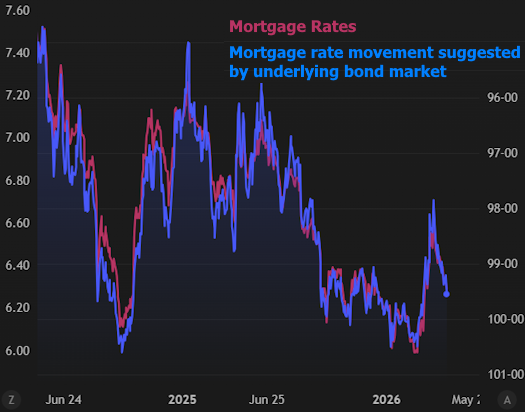
In other words, it's clear we're looking at the right part of the bond market. Now let's zoom in to a more granular view to see how we might account for Friday's fairly small drop in mortgage rates despite a larger movement in the bond market.
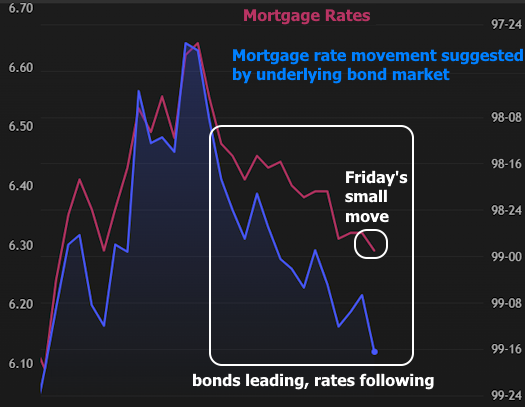
Simply put, the mortgage market almost never moves as quickly as the bond market suggests--especially on the way toward lower rates.
Based on that chart, you may be wondering if rates will fall next week in order to catch up to that blue line. Unfortunately, mortgage rates almost never move lower if bonds say they should move higher. For example, if the blue line bounces next week, the red line would almost certainly bounce too, but maybe not as much.
Bottom line: next week's rate direction will still be determined by the direction of movement in the bond market. In turn, that will likely be determined by the disposition of the Iran war--which has been the dominant driver for the entire financial market in recent weeks. The more "over" the war is (and the more the Strait of Hormuz is "open"), the better the odds of lower rates. Conversely, if there are hiccups in the peace process, rates could still bounce higher.