



Builder sentiment weakened further in July as affordability challenges and ongoing economic uncertainty continued to weigh on the market for new single-family homes. The National Association of Home Builders (NAHB)/Wells Fargo Housing Market Index (HMI) slipped two points to 34, marking the 15th consecutive month the index has remained below 40--the longest such stretch since 2012.
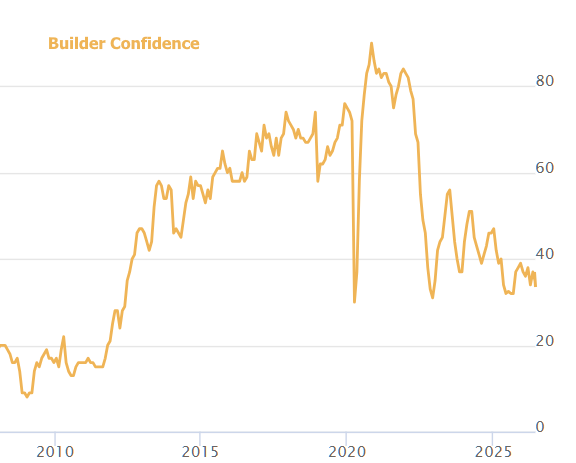
The latest reading reflects persistent headwinds for the industry, with elevated mortgage rates, rising material costs, expensive land and ongoing labor shortages continuing to limit both builder confidence and buyer demand.
All three major components of the index moved lower in July. Current sales conditions declined one point to 37, while sales expectations over the next six months fell two points to 43. Traffic of prospective buyers also dropped two points to 23, indicating many prospective purchasers remain on the sidelines.
“Many potential buyers remain on the sidelines as they wait for lower mortgage rates, more certainty on inflation and a clearer economic outlook,” said NAHB Chairman Bill Owens. He added that the recently enacted 21st Century ROAD to Housing Act includes provisions intended to address land-use, zoning, regulatory and financing challenges, though those reforms will take time to produce results.
NAHB Chief Economist Robert Dietz said affordability remains the industry's biggest obstacle, citing elevated mortgage rates, costly land, rising material prices and persistent skilled labor shortages. While he called the new housing legislation a positive step toward expanding supply and lowering housing costs, he noted that additional policy changes at the state and local levels will be needed to meaningfully improve conditions.
Builders continued to rely on pricing incentives to attract buyers. In July, 37% of builders reported cutting prices, up from 35% in June, while the average price reduction held steady at 6%. The use of sales incentives also edged higher to 63%, marking the 16th consecutive month that at least 60% of builders offered incentives.
Regional three-month moving averages were mixed. The Northeast increased one point to 45, the Midwest rose two points to 45, the South slipped one point to 33 and the West declined one point to 26. Overall, the report suggests builders continue to face a difficult operating environment as affordability constraints keep both construction activity and buyer demand under pressure.