



Pending home sales declined again in July as elevated mortgage rates and record-high home prices continued to weigh on buyer demand. The National Association of REALTORS® (NAR) Pending Home Sales Index (PHSI), which tracks signed contracts on existing homes, fell 2.3% from June and was down 2.2% from a year earlier, reaching its lowest level since January 2026.
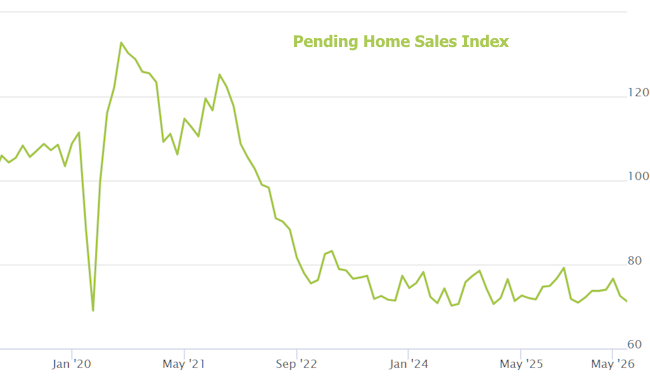
The latest report points to continued affordability challenges for prospective buyers. Higher borrowing costs and elevated home prices are keeping many buyers on the sidelines, while homes are taking longer to sell and fewer buyers are bidding above asking prices compared with a year ago.
“The highest mortgage rates of the year hit right in the middle of summer, and that’s pulling back contract signings,” said NAR Chief Economist Lawrence Yun. He noted that record-high home prices are also contributing to longer marketing times, though conditions vary considerably across local markets.
Yun added that job gains could bring more buyers into the market if mortgage rates stabilize or decline, although the effects of stronger employment take time to show up in housing activity. Pending contracts are currently 30% below their 2019 level, while payroll employment is 5% above its pre-pandemic level, suggesting a significant amount of potential demand remains on the sidelines.
Contract activity declined in all four major regions during July. The Northeast posted a 2.0% monthly decline, while the Midwest fell 0.7%. The South decreased 2.2%, and the West recorded the largest decline at 4.7%. Compared with a year earlier, pending sales increased 1.7% in the Midwest but declined 0.2% in the Northeast, 3.0% in the South and 7.1% in the West.
The regional results highlight the uneven nature of the current housing market, with the Midwest continuing to outperform other parts of the country while the West faces more pronounced weakness. Overall, the July data suggests that affordability pressures and elevated borrowing costs continue to limit buyer activity, even as improving employment conditions point to substantial pent-up demand if housing affordability improves.