
Mortgage rates just had their best week since late March with the average lender down a whopping 0.27% from last Friday. That would be welcome news under any circumstances, but it's especially striking in a week when the biggest economic reports offered what would normally be compelling reasons for rates to move higher.
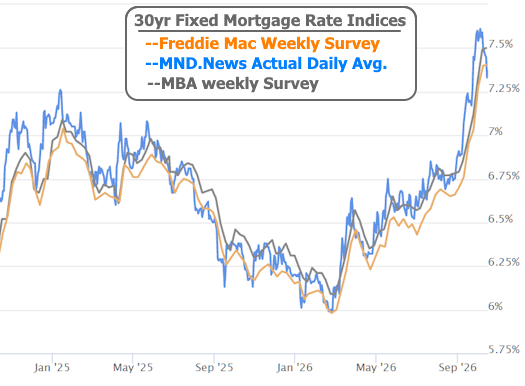
Last week, we noted some early evidence that rates could be forming a ceiling, but warned that higher-than-expected inflation data this week could quickly undo the improvement. As it happened, inflation wasn’t just higher than expected, it was broad-based, showing up in categories that couldn't simply be explained by higher fuel costs. At first glance, that looked like the end of the road for the rate recovery, but then the paradox kicked in, and rates ultimately moved lower.
How do rates fall after hot inflation data?
The clearest example of the paradox was Wednesday’s Consumer Price Index (CPI). Core CPI rose 0.335% versus the 0.2% forecast. That's a monthly annualized pace of 4%. Considering the Fed targets 2% inflation, it was no surprise to see the bond market react negatively at first with the day's initial average mortgage rate rising 0.10%, a very big move for a single day.
But roughly half an hour later, rates began a steady recovery while stocks sold off sharply, on their way to the worst day in over 2 months. By the close, the average lender was actually 0.01% LOWER than Tuesday, something that seemed all but impossible earlier in the day.
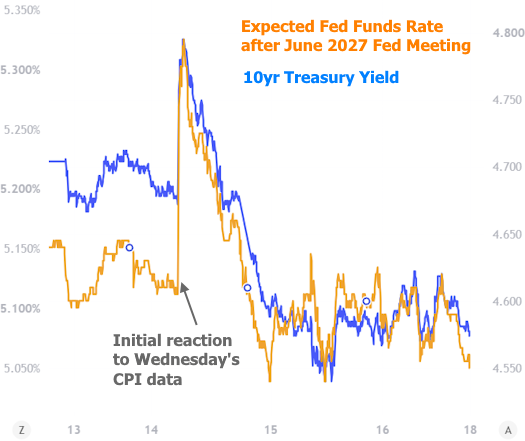
That strong momentum carried through Thursday, with rates falling another 0.12%, the biggest one-day drop in at least 3 months, despite another inflation report (PPI) showing higher-than-expected prices.
Two things explain most of it. The first was tech. Worries about an AI-related pullback, including fears that trouble at companies like CoreWeave could spread to others, pushed investors out of stocks and into bonds (higher demand for bonds = lower rates, all else equal).
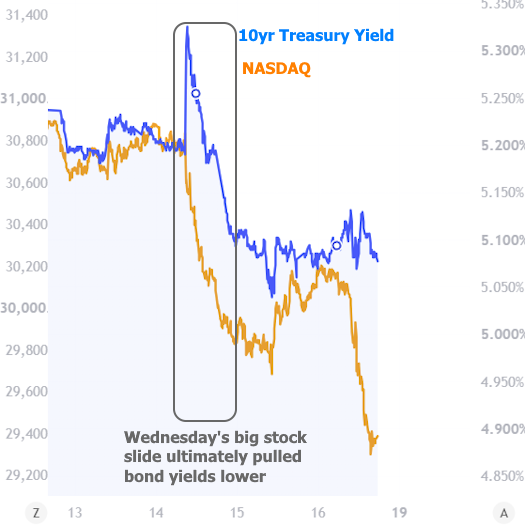
The second was timing. Yields recently hit multi-decade highs, and investors had been waiting for a level attractive enough to start buying, much like they did when the 10yr hit 5% in 2023. The tech jitters gave the fence-sitters the push they needed.
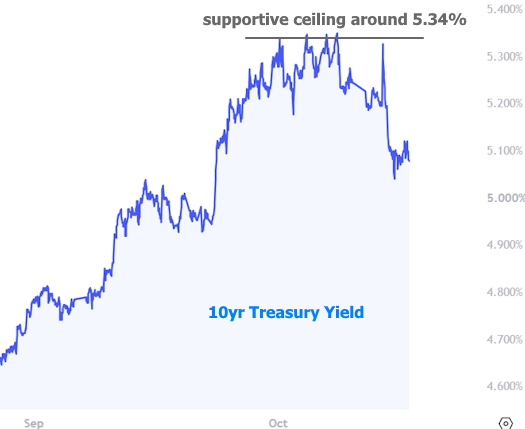
Friday offered the first hint of pushback. Rates rose 0.04%, a small move in context, but a notable one because the NASDAQ had an even worse day than it did on Wednesday and bonds didn't see any benefit this time. It's too early to read much into a single day, but it hints that the rally may be running into some resistance after such a big run.
What could happen from here?
The if/thens are fairly simple. If the tech jitters continue, or economic data weakens in a more convincing way, then bonds would have fresh motivation to rally and rates could keep improving. The strongest case for a bigger move lower would be a sustained economic slowdown, ideally alongside an end to the war. It's good to consider how long both of those things could take to play out.
Conversely, if the tech fears fade and economic data stays resilient, bonds would lose a good amount of the support they’ve enjoyed, leaving this week’s hot inflation data with less to offset it.
For now, this was a rare week where bonds looked past bad inflation news, with plenty of help from tech stocks. Whether it turns into something bigger depends on whether that help sticks around.