

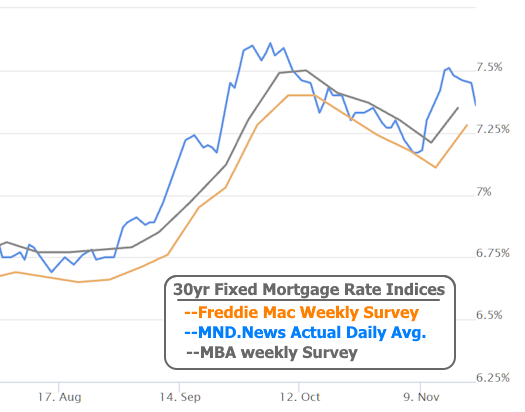
After starting the week near the highest levels in over a month, Mortgage rates ended at their lowest levels since November 10th, with nearly all of the improvement arriving on Friday.
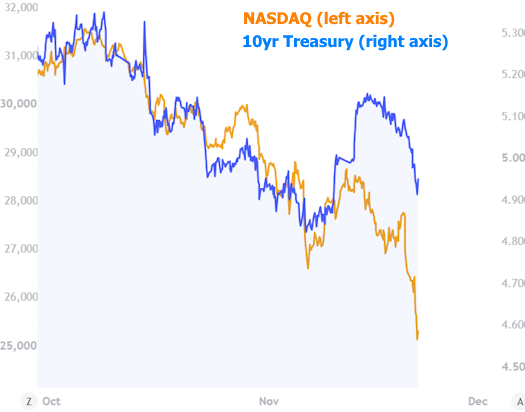
Last week we noted that rates would require more and more weakness in the tech sector in order to move much lower. For most of this week, anyone watching the Nasdaq might reasonably have wondered how much more trouble it was going to take. Stocks kept working their way back toward their early November lows. Mortgage rates were inching lower in very small steps up until Friday.
The dividing line turned out to be the low the Nasdaq hit on November 6th. Back then, investors looking for a safer place for their money bought enough bonds to push Treasury yields to their lowest levels in months. Last week's inflation data made bond buyers reluctant to follow the stock selling this time around. It wasn't until the Nasdaq broke decisively below November 6th lows that bond buyers came back in force.
What can tech stocks tell us about the economy?
That's a trickier question than usual this week. Anthropic shares have taken a beating since the company went public, and Nvidia is still dealing with fallout of its own. It's easy to look at those two companies and see reasons the selling might overstate the trouble elsewhere. Then again, if you had to pick two companies whose fortunes might change investors' minds about the AI boom, those two would make a pretty good list.
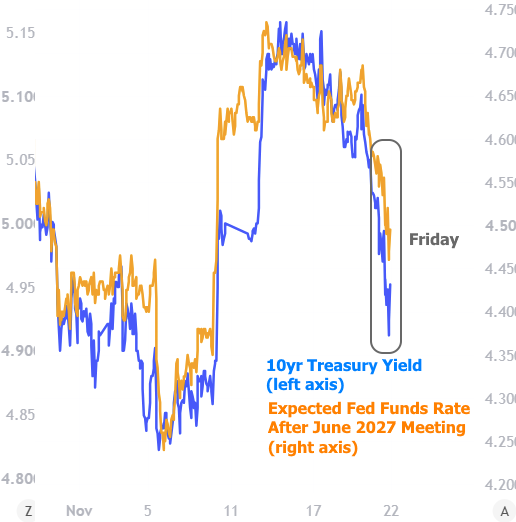
One place to see how seriously investors are taking that possibility is in their bets on the Fed. In the space of 24 hours between Thursday and Friday, the expected Fed Funds Rate after the June 2027 meeting fell by 0.20 percentage points. For perspective, that erased most of a typical quarter-point hike from the outlook without the benefit of any new major economic data.
If stocks keep falling, even a strong economic report or another uncomfortable inflation reading could get a smaller reaction from rates than we'd normally expect. After all, those reports tell us what happened last month whereas a massive stock sell-off carries more forward looking implications for the economy. Conversely, if stocks find their footing, it gets a lot easier for inflation data to reclaim the market's attention.
Next week adds the usual Thanksgiving caveats. Some traders will head home early. Others will want to get their trades done before everyone else heads home early. With fewer people around to take the other side, it can take surprisingly little buying or selling to move bond yields in either direction. Keep that in mind if rates seem to have a strong opinion on a day when there's very little news.