


Mortgage rates managed to build on last week's improvement despite an early threat from a resurgent tech sector and a surprisingly strong batch of economic data. By Wednesday, the average lender was back to the lowest levels since November 10th.
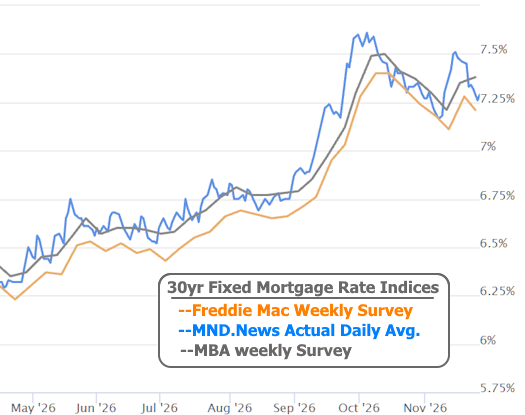
Last week we discussed the possibility that ongoing weakness in the stock market could take some of the sting out of economic reports that would otherwise push rates higher. The holiday-shortened week offered a great opportunity to put that theory to the test.
The first test came courtesy of Jensen Huang's reinstatement as Nvidia's CEO. The news prompted a massive rally in several tech stocks on Monday morning and threatened to push 10yr Treasury yields (a benchmark for longer-term interest rates) back above 5%.
Interestingly enough, the bond market managed to recover most of its losses even before stocks resumed their slide. With additional stock market weakness on Tuesday and Wednesday, Treasury yields made it back to the territory seen in early November.
Speaking of economic data, Wednesday's reports showed the economy growing at a substantially faster pace than expected in the 3rd quarter (4.3% versus a median forecast of 3.5%). Business investment in equipment was also stronger than expected, and new claims for unemployment benefits fell below 190k.
Even though all of the above would typically put upward pressure on rates, the bond market barely flinched.
Part of the explanation was that Wednesday's PCE inflation report was fairly well behaved compared to the reports from earlier in the month. But there's also an increasingly interesting juxtaposition between the strength of the economy as measured by recent economic reports and the concerns being expressed by investors in the stock market.
Consider how much of the recent economic growth has been predicated on massive investments in AI infrastructure. If investors are beginning to question the sustainability of that level of spending, there are implications for everything from future economic growth to the amount of money companies will need to borrow (this borrowing adds to overall bond market issuance and put significant upward pressure on rates in 2026).
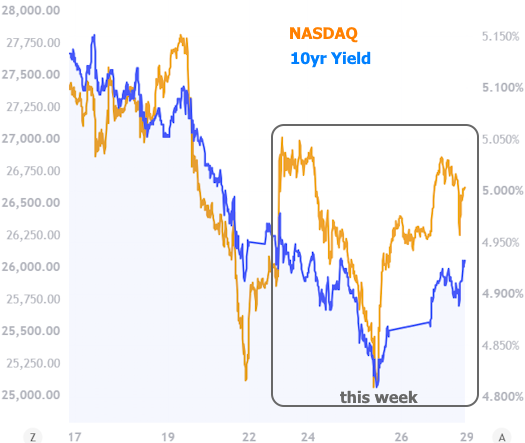
Bottom line: tech stock turmoil could be a better forward looking indicator for the economy and interest rates than the backward-looking economic reports that traditionally influence the bond market.
It should also be noted that Thanksgiving week is "weird" when it comes to financial markets. In not so many words, there's simply some additional uncertainty about trading levels and trends due to the relatively small number of traders participating in the market. The first few days of December should give us a better sense of where things stand.
If stocks remain under pressure and the economic data starts to show signs of weakness, the combination could help mortgage rates make a more convincing attempt to revisit their early November lows. Conversely, a sustained recovery in the stock market would leave rates much more exposed to the sort of strong economic data we've been seeing lately.